

The ATDT project developed digital resources to enhance farmers agency and facilitate the co-creation of knowledge for scaling agroecological practices.
The project demonstrated that digital tools grounded in social inclusion and science can address the diverse technical and human aspects of agroecology, and expand the use, creation and assessment of locally relevant sustainable practices.
Project conclusions
Access, usability, and co-creation: Expand inclusion and strengthen farmer empowerment and climate-informed agroecological transitions.
Principles for inclusion: Engage diverse farmers, enhance access, co-create farming practices, use technology appropriately, use farmer’s data and develop tools responsibly.
Bridging social and digital gaps: Trusted advisors and organizations, community leaders, and youth play a key role in ensuring lasting engagement and adoption.
Avoid pitfalls: Top-down information delivery, extractive data practices and business models, developing redundant tools, excluding farmers in the development.
Co-creation builds agency: When farmers help design tools and practices, they gain ownership, integrate diverse knowledge, and shape more sustainable solutions.
Resources
Findings
ATDT assessed the global and two local digital ecosystems, improved digital tools to engage farmers in the co-creation of knowledge, and evaluated innovations for scaling up climate-informed agroecological practices using digital tools.
Co-creation of knowledge
What is co-creation?
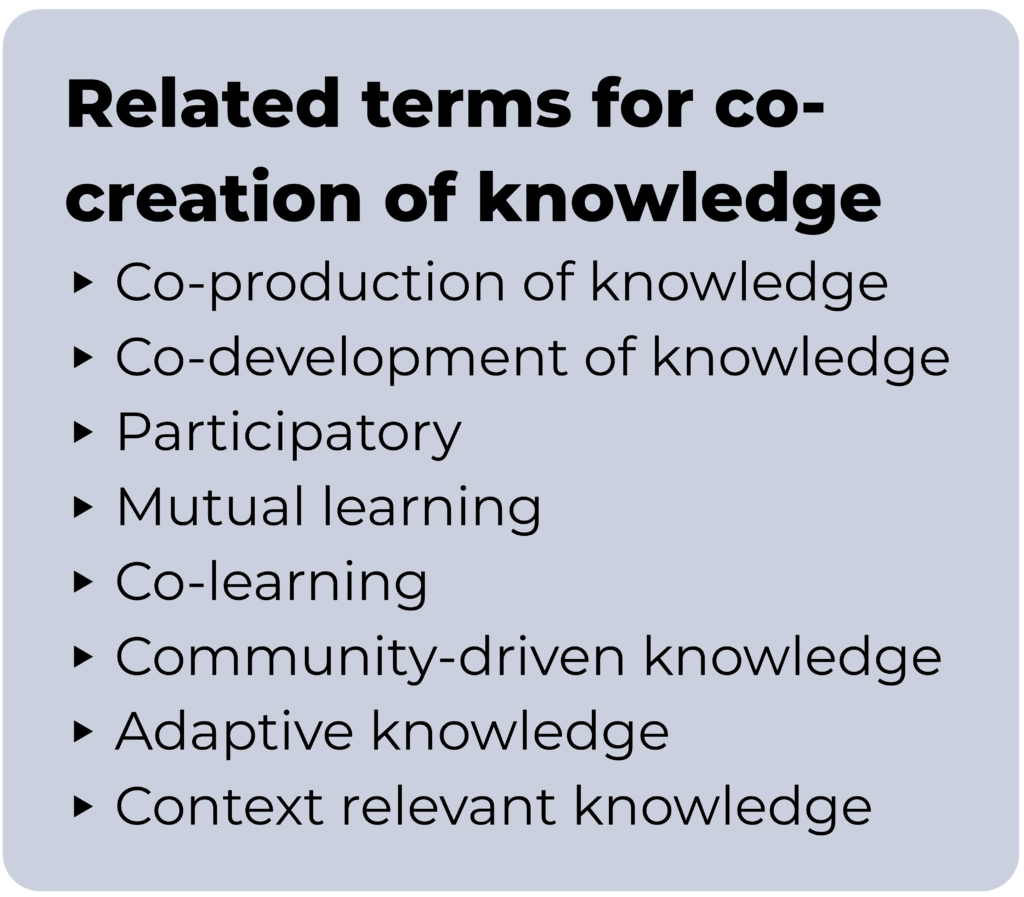
Co-creation of knowledge is the process of bringing together the knowledge systems of different groups, recognizing that each party brings distinctive perspectives and that working together can produce better results. Co-creation is a continuous process in which those participating need to have real influence. If not, the power stays with the technology developers.
Features of digital tools that support co-creation of knowledge, digital agency, and scaling of agroecology practices include elements that enable knowledge integration, two-way communication, inclusive access, and responsible use.
Resources: Digital agency framework to co-creation of agroecology practices | Co-creation applied to digital innovations for smallholder farmers: An example from Brazil | FarMoRe provides an inclusive digital solution to co-create agroecology at scale for rice production in Vietnam
Principles for inclusion of smallholders in digital tools
The ATDT project developed and applied six principles for socially inclusive digital tools that emphasize engaging diverse farmers, use responsible design, co-creation of knowledge, equitable access, farmer agency, data rights, and social inclusion. The principles were developed to address concerns with the current digitalization of food systems and from work with farmers in Brazil and Vietnam.

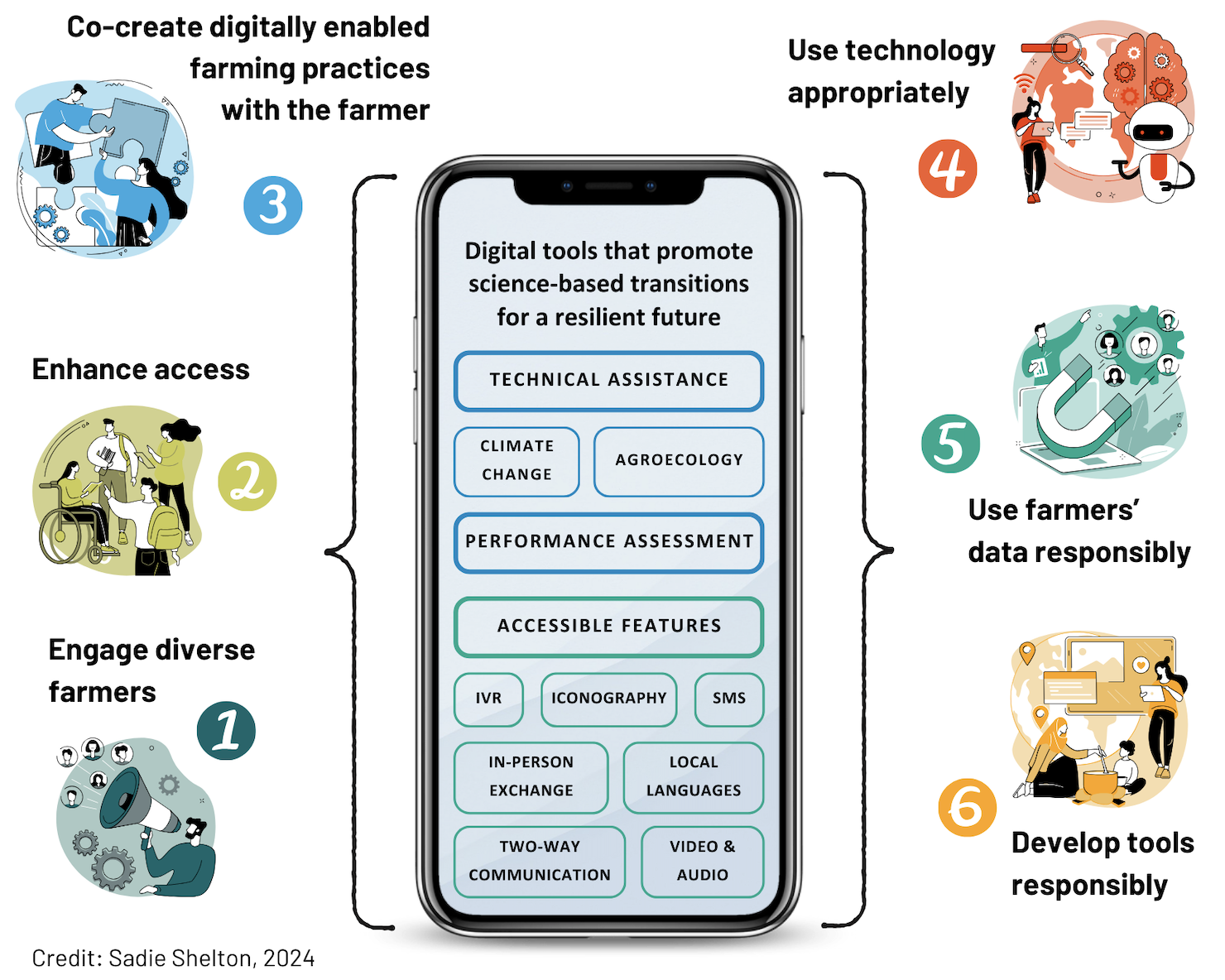
Principles for socially inclusive digital tool features
Resources: Principles for climate change | Social inclusion of tools for agriculture | Critiques of digital tools for agriculture
Using digital tools to scale agroecological practices
Review of digital tools [2022]
We conducted expert interviews and a review of digital resources relevant to climate change and agroecology to identify exemplary features of digital tools. Overall, we found few digital tools with functions for agricultural technical advice and performance assessment related to agroecology and found limited climate change adaptation and mitigation information. However, many have components of agroecology (44 of 230). Of these 44:
- <20% of tools supported climate change action
- ~33% addressed 4 or fewer agroecology principles
- About half addressed whole-system design
- ~30% of tools included features for communication with tool users
- 25% had farmer-driven content such as agro-advisory videos recorded by farmers
- 43% had 2-way communication such as SMS, voice calling, or in-app communication
Related resources: Global digital tool database | Digital tools for climate change adaptation & mitigation | Brazil digital tool review | Vietnam digital tool review
Solis | Brazil | Livestock | Technical assistance
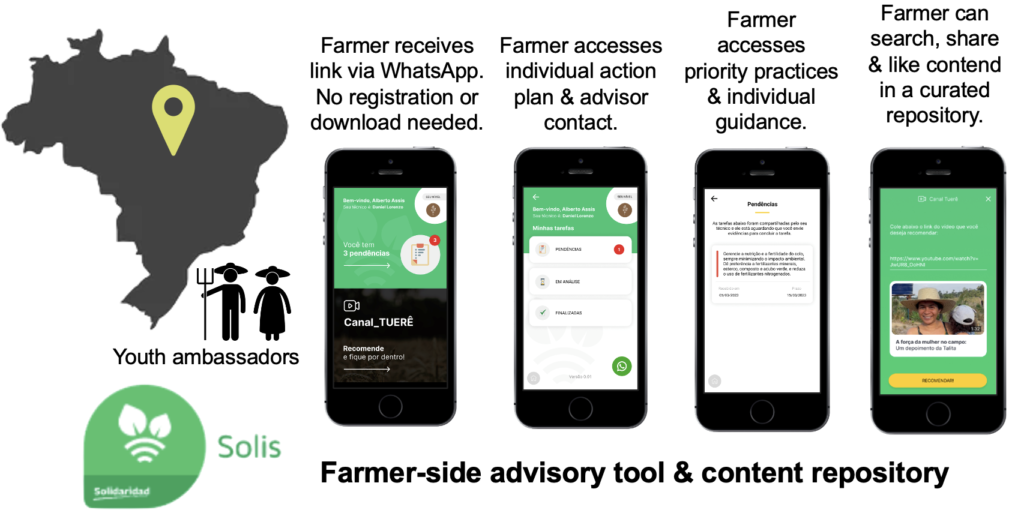
Led by Solidaridad Latin America, ATDT supported the improved use of good agronomic practices and traceability tools for incentives to smallholders and recognition of their livestock production practices. The team worked in the Amazon agriculture frontier of the states of Pará and Mato Grosso, Brazil. With this purpose in mind, the Brazil team reviewed the inclusivity of existing tools, map and systematize knowledge on production practices, and influence tool access, design, and improvement to support agroecological transitions.
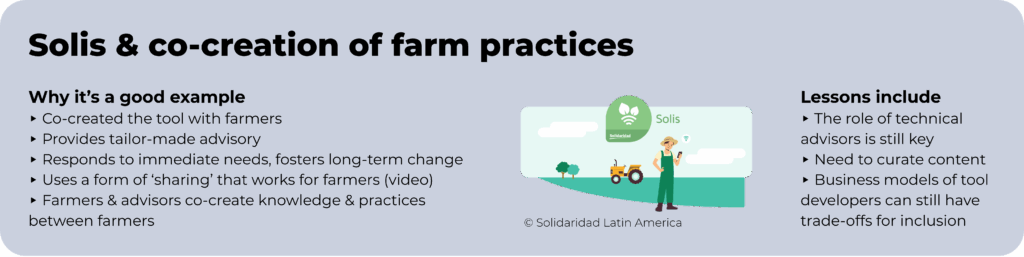
Solis, developed for technical assistance, emphasizes the human component by curating farmer-generated content through a social media-like interface. The tool combines top-down (expert-to-farmer) with bottom-up (farmer-to-expert) & peer-to-peer (farmer-to-farmer) communication channels to foster the co-creation of locally relevant agroecological practices.
A pilot ambassador program for youth is helping to drive content creation with plans to monetize the program for community leaders to incentivize quality content. However, funds must come from somewhere. While the app is free for farmers, it still must pay for itself. A fee-for-service model via Solidaridad Latin America’s Extension Solution platform sustains Solis and supports content curation.
Resources: Review of tools | Brazil training material | Learnings from Brazil | Co-design of digital tools in Brazil
FarMoRe | Vietnam | Rice | Performance assessment
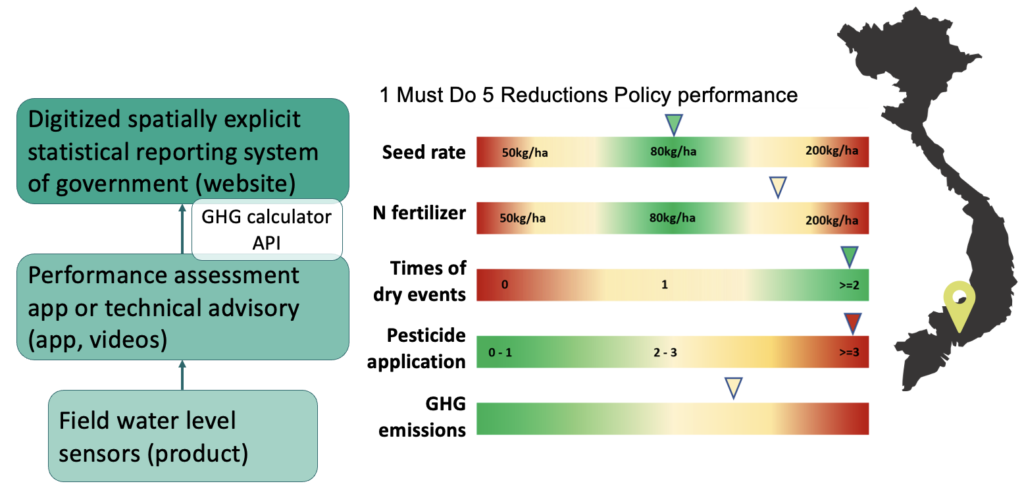
Sustainability standards are prominent within Vietnam in higher-value crops, like coffee and cocoa. However, they are less prevalent in staple crops, like rice. To address this in Vietnam’s Mekong River Delta region, the International Rice Research Institute (IRRI) and local stakeholder partners, will support the development, design, and improvement of digital tools facilitating agroecological practices for rice farmers. The Vietnam team and IRRI will focus research on advanced farming packages that promote agroecological production and reduce greenhouse gas emissions while enhancing farmers’ income.
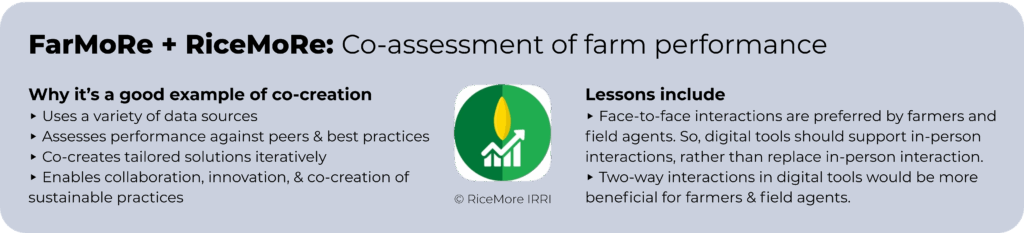
FarMoRe is a farm management app designed for performance assessment. Through a rice GHG calculator, farmers and extension agents receive data on GHG emissions from practices over time.
Integrated into the national system, RiceMoRe, a digital platforms providing near-real-time tracking and streamlined reporting across multiple management levels, FarMore uses a relevant set of metrics to provide scalable, data-driven benchmarking of improved rice practices. By embedding FarMoRe into government extension and carbon finance systems, the project demonstrated how digital tools can make performance scalable while maintaining farmer participation and ownership.
Resources: Vietnam review of digital tools | Lessons from using digital tools in Vietnam | Vietnam Training material | Digital co-creation in Vietnam
Digital innovation process with farmers: Lessons learned
ATDT country teams co-designed two digital tools with farmers, Solis in Brazil for livestock and FarMoRe in Vietnam for rice, each demonstrating different approaches to integrating TA and PA while following agroecological principles and ensuring farmer engagement and long-term sustainability.
Both tools emphasized two-way communication, peer exchange, and capacity building for farmers and intermediaries. FarMoRe provided quantitative assessments for GHG emissions, yield, and input efficiency, while Solis focused on qualitative peer learning through video and social platform engagement. The critical role of intermediaries in bridging digital and social gaps was revealed in both cases. Both tools increased farmer agency by facilitating in-person and virtual peer learning and communication among farmers, technical advisors and researchers–encouraging localized content creation and supporting participatory monitoring aligned with national and global sustainability indicators.
These tools illustrate how digital platforms can support co-creation of sustainability practices through iterative design, training, and partnerships.
Resources: Vietnam digital profile | Digital co-creation in Vietnam | Learnings from Brazil | Co-design of digital tools in Brazil
Reports: Brazil baseline study | Vietnam baseline study | Brazil farmer workshops | Vietnam farmer workshops
How to achieve digital inclusion
Using a digital agency-based model
Leveraging responsible hybrid collective intelligence, integrating the process of knowledge co-creation and data into digital tools supports the generation of local solutions to contribute to large-scale transitions to sustainable agriculture. Features of digital tools that support knowledge co-creation, digital agency, and scale agroecology practices, enable knowledge integration, two-way communication, inclusive access, and responsible use.
Therefore, a step-wise approach is needed to develop digital resources that enable farmers’ digital agency and support the scaling of agroecological practices. The addition of co-creation as a central focus to how we approach social inclusion results in the updated digital inclusion model in the figure below.
IMAGE CAPTION: A digital agency based framework for social inclusion showing the barriers to farmers’ participation in digital knowledge systems.
Exemplary Features: Digital tools for climate change adaptation & mitigation & Exemplary features of digital tools for agroecology
Recommendations to support co-creation & digital agency
Supporting farmers’ digital agency and co-creation of knowledge requires intentional design choices that reduce digital barriers, elevate local knowledge, and ensure responsible, context-appropriate use of digital tools. Practical suggestions include:
- Work with intermediaries: Local advisors are essential to bridge digital gaps.
- Design for community fit: Build on existing dynamics, diversity, and capabilities.
- Plan for ethics: Identify risks early and prepare for unintended consequences.
- Keep tools simple: Prioritize usability and real value over complexity.
- Provide offline options: Offer versions that run with low power and connectivity.
- Adapt what exists: Strengthen and reuse good-fit tools rather than adding new ones.
Resources: Vietnam Training Material | Brazil Training Material | Digital agency framework to co-creation of agroecology practices
Stepwise approach to developing digital resources
Digital tools are never stand-alone solutions. A stepwise, participatory process helps ensure they add real value to farmers and support the scaling of agroecological practices. The ATDT brief outlines the following approach for developing effective, inclusive digital resources:
Step 1. Define the problem with farmers: Identify who is affected and how.
Step 2. Set impact goals together: Focus on what outcomes matter most to farmers.
Step 3. Choose the right solution: Decide whether digital tools are needed and what else is required with farmer input.
Step 4. Align digital and human intelligence: Clarify roles for tools, intermediaries, and co-creation.
Resources: Digital agency framework to co-creation of agroecology practices
About ATDT
The digital divide has further disadvantaged farmers already living on the margin, including women and smallholders as the last to benefit from new technology. To expand agroecological approaches with digital tools, it is essential to support inclusive use and farmer co-design of knowledge.
The Agroecological TRANSITIONS’ Inclusive Digital Tools (ATDT) project engaged farmers to identify opportunities for improving tools and developed innovations to enhance inclusiveness, enable farmers to develop new practices, and integrate climate change resilience and mitigation with agroecological goals. Country teams co-designed two digital tools, Solis in Brazil for livestock and FarMoRe in Vietnam for rice, through in-person workshops with farmers and agricultural extension staff to identify opportunities for addressing farmer needs and scaling agroecological practices through digital resources.
Vietnam, Mekong River Delta | Rice systems
Led by the International Rice Research Institute (IRRI) the team collaborated with farmers to refine and test digital tools that support agroecological rice production. This included developing and adapting advanced farming packages to reduce GHG emissions, increase efficiency, and improve farmer income. The work also highlighted how digital platforms can broaden access to sustainability practices in staple crops, where formal standards are less common.
Brazil, Pará & Mato Grosso | Livestock landscapes
With Solidaridad Latin America, the Brazil team adapted an existing tool for extension agents livestock-oriented tool for technical assistance and knowledge co-creation for smallholder farmers. The team mapped local knowledge, assessed barriers to tool access, and co-developed features that help accelerate agroecological transitions in Amazon frontier landscapes. This work is ongoing.
The Agroecological TRANSITIONS Program
The CGIAR’s Agroecological Transitions Program for Building Resilient and Inclusive Agricultural & Food Systems (TRANSITIONS) aims to align policy, investment, and technical support to enable climate-informed agroecological transitions by farmers in LMICs. Within the program are three components, exploring how to capture agroecological performance using holistic metrics, leveraging digital resources to enhance farmer’s agency and facilitate the co-creation of knowledge for scaling agroecological practices, and developing inclusive incentive structures for private sector and private-public stakeholders.
Outputs
Journal articles
Briefs
Digital agency: Empowering farmers to co-create knowledge on agroecology practices
Transforming family farming: Advancing inclusive digitalization in the Amazon
Inclusive Digital Tools for Agroecological Transitions [poster]
Co-creation applied to digital innovations for smallholder farmers: An example from Brazil
Socially inclusive decision support tool for smallholder sustainable intensification and soil health
Digital tools for supporting climate-informed agroecological transition in beef production in Brazil
Key actions to develop inclusive digital resources for smallholder cattle ranchers in Brazil
Best practice guidance for inclusive digital tool development for sustainable rice in Vietnam
Socially inclusive digital tools for agriculture: A way forward
Digital tools for climate change adaptation & mitigation
Reports
Brazil Training material: Sustainability curriculum for livestock production
Outcome Report: Agroecological Transitions: Inclusive Digital Tools (ATDT)
Principles for socially inclusive digital tools for smallholder farmers: A guide [UPDATED: Version 2]
Use of digital tools in sustainable rice production in the Mekong Delta, Vietnam
Field testing digital tools insustainable rice production in the Mekong Delta, Vietnam
Improving rice sustainability [in Vietnam] through digital tools
Global digital tool review for agroecological transitions [data]
Livestock practices, use of digital tools and co-design and flow of information: Brazil baseline
Relatoria das entrevistas e webinar para o levantamento de percepções de representantes da cadeia da pecuária sobre o desenvolvimento de recursos digitais inclusivos na implementação de boas práticas (Portugeues, includes EN Summary)
Blogs
OCT 2024: Put farmers first when scaling agroecology tech, say experts
MAR 2024: What’s needed to make agroecology mainstream?
DEC 2023: Solidaridad blog on co-creation workshops [Portuguese] [English]
SEP 2023: Use of digital tools in sustainable rice production in the Mekong Delta, Vietnam (CGIAR)
SEP 2023: TRANSITIONS: Inclusive digital tools to scale smallholder agroecology
AUG 2023: Brazil farmer workshop with Solidaridad
APR 2023: Inclusive digital tools to scale smallholder agroecology
JAN 2023: What makes an “exemplary” digital solution for agroecology?
NOV 2022: New TRANSITONS program tackles three roadblocks to scale up agroecology
Events
SEP 2024: Using digital tools to support climate & agroecological transitions at scale
FEB 2024: Transitions for our Futures [recording]
DEC 2023: COP28 Food Systems Pavilion Towards equitable food systems: Nourishing communities and empowering stakeholders
NOV 2023: Scaling up digital co-creation for sustainable rice and livestock practices
OCT 2023: Use of digital tools in sustainable rice production in the Mekong Delta, Vietnam
OCT 2023: OpenTeam In-Depth Collaborative Innovations in Digital Tools for Climate-Smart Agriculture
JUN 2023: Africa Agribusiness & Science Week Climate Change Resilience and Agroecology
May 2023: Aim4Climate Summit Digital resources for inclusive climate change action in agriculture
APR 2023: OpenTeam In-Depth Principles for Inclusion & Development [blog]
FEB 2023: Agroecology Transformation Partnership Platform First Annual Members Forum [blog]
NOV 2022: Best practices for digital tool inclusiveness and farmer co-creation
OCT 2022: Driving the Agroecological Transition [recording] [blog]
MAY 2022: Global Digital Development Forum: Farmer co-design of climate change solutions
Project: Inclusive Digital Tools to Enable Climate-informed Agroecological Transitions
Duration: 2021-2025 + ongoing
Funding: Funded by the European Union through its DeSIRA Initiative. Managed by the International Fund for Agricultural Development
The Agroecological Transitions for Building Resilient, Inclusive, Agricultural and Food Systems (TRANSITIONS) Program is funded by the European Union through its DeSIRA initiative and managed by the International Fund for Agricultural Development (IFAD). The TRANSITIONS Inclusive Digital Tools (ATDT) project aims to support the use of digital resources and citizen science to empower farmers to co-create, adapt, and innovate practices for climate-resilient and low-emission agroecological outcomes at large scales. Find a list of ATDT outputs here. The contents and opinions expressed in this publication are not peer reviewed and are the sole responsibility of the authors. They do not necessarily reflect the views of the European Union, IFAD or affiliated organizations.
The header photo was taken by JP Sinohin (IRRI, 2013) and shows Joan Villoria, an agricultural extension agent, and farmer Angel Bautista using the Rice Crop Manager in Los Banos, Philippines.
For more information, please contact Sadie Shelton, Communications Officer, ATDT.